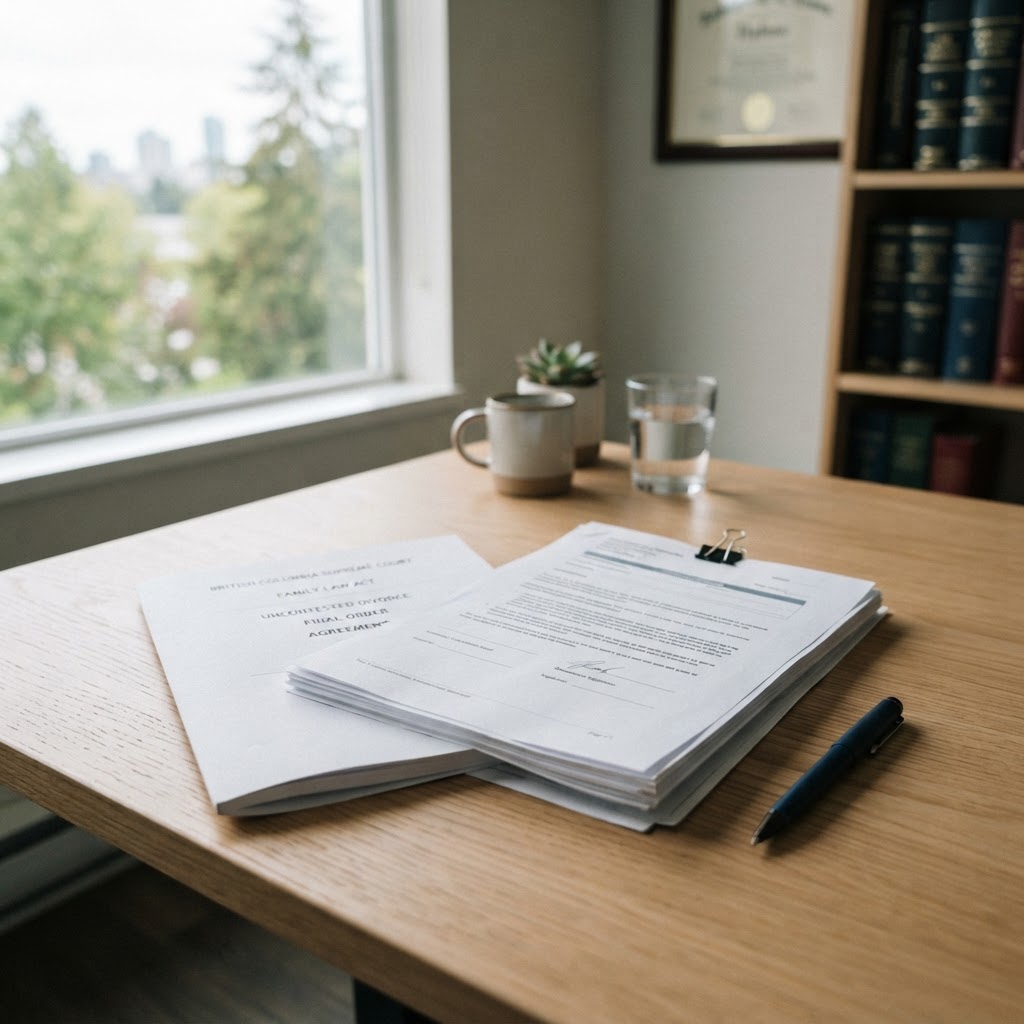
For spouses in Surrey who agree that their marriage should end and have resolved the issues that need to be addressed, a desk order divorce may offer a way to obtain a divorce order without attending a courtroom hearing. The process is paper-based, but it still requires accurate documents, proper service, and compliance with the rules of the Supreme Court of British Columbia.
This overview explains the general process. Every family situation is different, and a desk order application is not suitable for every couple. A divorce order legally ends a marriage; it does not automatically resolve parenting arrangements, child or spousal support, or property and debt division.
What is a desk order divorce?
A desk order divorce is an application for a divorce order that a judge considers based on filed documents, rather than hearing oral submissions at a scheduled courtroom appearance. In BC, the application is generally made in the Supreme Court of British Columbia. The court reviews the filed materials and may grant the order, ask for corrections or additional information, or require the parties to take another step.
People sometimes use “uncontested divorce” and “desk order divorce” as if they mean exactly the same thing. An uncontested divorce describes a divorce application that is not opposed. A desk order describes a way the court may decide the application on the written record. Whether a case qualifies depends on the facts, the documents, and the applicable court requirements.
When might the process be appropriate?
A desk order application may be worth exploring when the spouses are not disputing the divorce itself and the required legal issues have either been resolved or do not require the court to decide them as part of the application. The spouses must also meet the legal requirements for divorce, including the required connection to Canada and a legally recognized ground for divorce.
Most divorce applications rely on spouses having lived separate and apart for at least one year. The Divorce Act also recognizes adultery and cruelty as grounds, but those grounds involve different legal considerations. Do not assume that moving into separate homes is always necessary to establish separation. In some circumstances, spouses may live under the same roof while separated, but the evidence must support that they were living separate lives.
A case involving unresolved parenting, support, or property issues may need additional steps. A divorce order can sometimes be obtained while other claims continue, but the timing and approach should be considered carefully. For example, signing a separation agreement or obtaining a divorce does not, by itself, guarantee that every financial or parenting issue has been properly addressed.
Typical steps for a desk order divorce in BC
1. Confirm the legal and factual foundation
Before preparing forms, identify the ground for divorce, the date of separation, where each spouse lives, whether there are children of the marriage, and whether any related court orders or agreements exist. For a one-year separation, the application must be timed so that the statutory period has been met when the court grants the divorce.
Where children are involved, the court needs information about their arrangements and support. The parents should be prepared to show that child support arrangements are consistent with the applicable requirements. A private agreement may be relevant, but the court may still require information or clarification.
2. Choose the correct application route
Spouses may apply jointly, or one spouse may start the proceeding and serve the other spouse. A joint application can be practical where both people cooperate and agree on the requested divorce order. A sole application requires formal service and gives the other spouse an opportunity to respond. The correct route depends on the history and circumstances of the case.
It is important to distinguish a jointly prepared application from a sole application where the respondent simply does not oppose it. The forms and procedural steps can differ. Using the wrong route or incomplete forms can lead to registry requisitions and delay.
3. Prepare and file the court documents
The documents commonly include the appropriate notice of family claim or joint application materials, a registration certificate from the federal Central Registry of Divorce Proceedings, affidavits, and proposed orders. The precise documents depend on the route chosen and whether there are children or other claims. Current court forms and filing requirements should be checked before submitting anything.
Information must be consistent across the forms and supporting evidence. Names, marriage details, separation dates, addresses, children’s information, and requested orders should be checked carefully. If documents conflict or leave a required point unclear, the registry or judge may request corrections or further evidence.
4. Serve the other spouse when required
For a sole application, the initiating documents generally must be served in accordance with the applicable rules. Personal service is commonly required for the initial documents, and the person who serves them usually cannot be the applicant. Proof of service must then be filed. Special arrangements may be necessary if the other spouse cannot be located or is outside the jurisdiction.
Service is a formal legal step, not simply sending the papers by ordinary email or text. If service is not completed correctly, the divorce application may not proceed until the problem is fixed.
5. Apply for the divorce order
After the required response period and procedural steps, the applicant files the materials asking the court to grant the divorce. The judge reviews the written evidence. If satisfied that the legal requirements are met, the judge may make a divorce order. If something is missing or unclear, the court may return the materials with directions or require a further step.
6. Confirm when the divorce becomes effective
A divorce order usually takes effect 31 days after it is made, unless the court orders otherwise. The parties should obtain and keep the final divorce certificate for their records. Anyone planning to remarry should confirm that the divorce is effective and that the necessary certificate has been issued before making plans that depend on their marital status.
Common causes of delay
Using the wrong forms or an outdated version of a form.
Missing signatures, exhibits, required certificates, or proof of service.
Inconsistent dates or information between documents.
Not addressing child support information where children are involved.
Applying before the required separation period has elapsed.
Assuming an agreement resolves every issue when its terms are incomplete or unclear.
Failing to respond to a registry requisition or court direction.
A requisition is not necessarily a rejection of the divorce. It usually identifies a document or issue that must be corrected or explained before the judge can decide the application.
Does a desk order divorce settle everything?
No. The divorce order ends the marriage. It does not automatically decide how property and family debt are divided, who makes parenting decisions, the parenting schedule, child support, or spousal support. Some of these issues may be dealt with in a separation agreement or a separate court order. If they remain unresolved, they may require negotiation, mediation, or a separate court process.
Before applying, consider whether the terms of any separation agreement are clear about the issues that matter to your family. Pay attention to implementation details, such as how support will be paid, how changes will be handled, and what steps are needed to transfer or refinance a home. The legal effect of an agreement depends on its wording and the circumstances in which it was made.
Getting help with an uncontested divorce in Surrey
Even where both spouses agree, the forms and filing process can be technical. A family lawyer can help identify the appropriate application route, prepare or review documents, explain service requirements, and flag issues that could delay the application. The level of assistance needed depends on the complexity of the case and whether related matters have been resolved.
Law Boutique assists clients in Surrey and across British Columbia with family law matters, including divorce applications. To learn about the process and discuss your circumstances, visit our uncontested divorce service page or our family law page. You may also find our article on separation agreements in Surrey useful when considering related issues.
Ready to discuss an uncontested divorce in Surrey? Book a consultation with Law Boutique.